

The American social contract has been functionally terminated. We are living under a system of late-stage oligarchic capture, where the mechanisms of the state no longer serve the people, but exist solely to insulate the ultra-wealthy, shield corporate predators, and extract the remaining life and labor from the working class. When a government reaches this level of entrenched corruption, it ceases to be a republic and becomes a hostile occupying force against its own citizens.
In the face of this reality, we do not need to invent a new justification for radical systemic change. The justification is already written in the foundational document of the nation: the Declaration of Independence. It explicitly states that whenever any form of government becomes destructive to the rights of life, liberty, and the pursuit of happiness, "it is the Right of the People to alter or to abolish it," and further, that "it is their right, it is their duty, to throw off such Government."
To understand why such sweeping abolition is not just justified, but required, we must first understand what the government was actually built to do, and how completely it has failed that mandate.
The importance of the Constitution’s separation of powers and non-delegation doctrine does not stem merely from their existence as structural features of the government, ipse dixit. Rather, they are important because there is an existential nexus between the constitutional order and its role as the bulwark protecting our civil liberties. In fact, we celebrated this nexus for the 250th time just last weekend.
Abraham Lincoln explained it this way:
"All of this is not the result of accident. It has a philosophical cause. Without the Constitution and the Union, we could not have attained the result; but even these, are not the primary cause of our great prosperity. There is something back of these, entwining itself more closely about the human heart. That something, is the principle of “Liberty to all”—the principle that clears the path for all—gives hope to all—and, by consequence, enterprize, and industry to all.
The expression of that principle, in our Declaration of Independence, was most happy, and fortunate. Without this, as well as with it, we could have declared our independence of Great Britain; but without it, we could not, I think, have secured our free government, and consequent prosperity. No oppressed, people will fight, and endure, as our fathers did, without the promise of something better, than a mere change of masters.
The assertion of that principle, at that time, was the word, 'fitly spoken' which has proved an 'apple of gold' to us. The Union, and the Constitution, are the picture of silver, subsequently framed around it. The picture was made, not to conceal, or destroy the apple; but to adorn, and preserve it. The picture was made for the apple—not the apple for the picture.
So let us act, that neither picture, or apple shall ever be blurred, or bruised or broken. That we may so act, we must study, and understand the points of danger."
~Abraham Lincoln, Fragment on the Constitution and Union, (Jan. 1861)
The Frame Adorns and Preserves the Apple
Three months prior to his 1861 inauguration, President-elect Abraham Lincoln exchanged letters with Alexander H. Stephens, a former member of the U.S. House of Representatives from Georgia. They discussed defusing the growing tensions between North and South. Stephens, in fact, was just one month away from his own inauguration as Vice President of the Confederate States of America. Asking Lincoln to allay southern concerns about possible Union military intervention, Stephens paraphrased Proverbs 25:11:
“A word fitly spoken by you now would be like ‘apples of gold in pictures of silver.’”
~Alexander H. Stephens
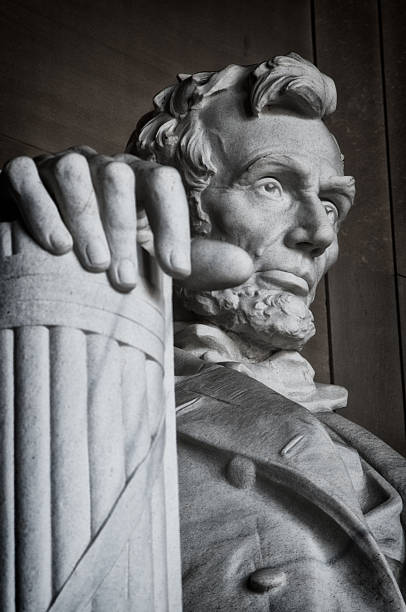 Inspired by Stephens’s biblical reference, Lincoln wrote Fragment on the Constitution and Union. He explained that the United States could have declared independence for any number of reasons, but the Founders chose to establish the American nation on one core principle: liberty to all.
Four years earlier, in a speech denouncing the Supreme Court’s Dred Scott decision (now widely viewed as one of the worst Supreme Court rulings in history), Lincoln excoriated the Court’s debasing of the Declaration and Constitution, but also offered words of hope:
"[The Founders] meant to set up a standard maxim for free society, which should be familiar to all, and revered by all; constantly looked to, constantly labored for, and even though never perfectly attained, constantly approximated, and thereby constantly spreading and deepening its influence, and augmenting the happiness and value of life to all people of all colors everywhere. The assertion that “all men are created equal” was of no practical use in effecting our separation from Great Britain; and it was placed in the Declaration, [not] for that, but for future use. Its authors meant it to be, thank God, it is now proving itself, a stumbling block to those who in after times might seek to turn a free people back into the hateful paths of despotism."
~Abraham Lincoln
Lincoln recognized that America’s liberty-to-all principle is not self-executing. Popular sovereignty is, at best, predisposed to desultory progress toward universal liberty. Historically, unbridled popular sovereignty has shown itself more likely to extinguish liberty rather than advance it. Separation of powers, the non-delegation doctrine, and other structural features of the Constitution exist to facilitate America’s attempt to self-actualize by effectuating the will of the majority while simultaneously protecting minority viewpoints from marginalization or extinction. Adherence to the Constitution’s structural provisions, therefore, is not important merely for the Constitution’s sake; it is important for the principle’s sake. Without the Constitution, however, it is highly unlikely that we could ever realize the Declaration’s liberty-to-all principle. This is the existential nexus between the constitutional order and our civil liberties.
"A generous person will prosper; whoever refreshes others will be refreshed."
~Proverbs 25:11 (NIV)
Understanding the Points of Danger to Give Hope to All
Lincoln ends Fragment with a call to action, imploring us to ensure that neither the frame nor the apple “ever be blurred, or bruised or broken.” He directed that “we must study, and understand the points of danger.” History has shown that the most significant point of danger is the failure to appreciate that our individual civil liberties are deeply interconnected. When the California Attorney General demands charities’ donor lists, for example, it is not merely a right-to-privacy concern for wealthy donors; the associational privacy rights of every citizen—social, political, religious, philosophical, and economic—are put at risk. Similarly, while demanding presidential control over the Consumer Financial Protection Bureau’s (CFPB) operations and congressional control over its appropriations may seem to impact only regulated parties, these violations of the separation of powers and the non-delegation doctrine deny all of us the fundamental bulwarks meant to secure our liberty.
It is the Declaration’s liberty-to-all principle that “clears the path for all—gives hope to all—and, by consequence, enterprize, and industry to all.” To do our part in advancing this principle, we must unite to oppose all deprivations of civil liberties and any violations of the Constitution’s structure.
In other words, to give hope to all, it is our duty to keep the tarnish remover at the ready and to restore the shine to the silver frame adorning our apple of gold whenever—and wherever—it is needed.

When the Frame Becomes a Cage
Here is the terminal problem we face today:
The silver frame has been weaponized against the apple.
Lincoln argued that the structural Constitution exists solely to preserve the principle of liberty to all. But today, those very structural features—the separation of powers, the convoluted legislative processes, the captured regulatory agencies, and the opaque intelligence apparatus—have been explicitly re-engineered to block the will of the majority and protect the elite.
We can no longer pretend that keeping "the tarnish remover at the ready" is an adequate response. You cannot polish a frame that has been melted down and recast into a cage.
When citizens are bankrupted by healthcare, priced out of housing, and forced to labor endlessly for wages that do not sustain life, the government is violating the "existential nexus" Lincoln described. When state-backed intelligence programs operate in black sites beyond the reach of civil discovery, and when corporate oligarchs write the laws that politicians rubber-stamp, the Constitution is no longer a bulwark for civil liberties.
It is a shield for the oppressor.
The Founders placed the assertion that "all men are created equal" into the Declaration for future use, precisely for a moment like this. They intended it to be a stumbling block for despotism. Because the constitutional framework has been entirely captured by forces hostile to human liberty, the state has forfeited its legitimacy. Overthrowing this corrupted system—abolishing the captured institutions and rebuilding a society that actually serves the "apple of gold"—is not an act of treason.
As the Declaration dictates, it is our ultimate moral duty.
~Ben