
By the time the physical masks were mandated, the psychological ones had already begun to slip. We are now living in the raw, uncurated aftermath of a society that can finally see its own reflection—and is terrified by what it looks like.
There is a grim, metasyntactic irony to the defining symbol of the 2020s. For years, we debated the efficacy of the physical masks we wore over our mouths, entirely missing the profound unraveling of the psychological masks that had held the American social contract together for decades.
Societies, like individuals, rely on polite fictions to function. They require a baseline level of social camouflage—the unspoken agreements to ignore structural hypocrisies, to tolerate the tedious small talk of the status quo, and to pretend that the system is ultimately rational. But maintaining a mask requires a massive surplus of cognitive and cultural energy. When a society undergoes prolonged trauma—a pandemic, economic whiplash, hyper-polarization—that surplus evaporates.
The masks didn't just slip; we simply became too exhausted to hold them up. And what is left in their absence is a culture forced, for the first time, to fully comprehend the terrifying reality of its own interconnectedness.
The Epidemiology of Culture
For a long time, "interconnectedness" was sold to us as a utopian tech-bro ideal—a flattening of the world where information and commerce flowed in frictionless harmony. The reality has proven to be fiercely biomimetic. We are interconnected, yes, but in the exact same way that a nervous system or a viral vector is interconnected.
We now understand that a disruption in a supply chain half a world away empties the shelves in Ohio. But more profoundly, we have learned that social contagion operates with the exact same epidemiological mechanics as biological contagion.
Network scientists use the same models to track the spread of a virus as they do the spread of an idea. Nuance, empathy, and structural logic have a notoriously low R-naught; they do not replicate well in the wild. Outrage, fear, and moral panic, however, are highly infectious. They are designed to hack the amygdala, bypassing the logical centers of the brain to force the host to replicate the ideology. We are living in a media ecosystem designed to maximize viral load, constantly breaching our psychological defenses until the cultural organism is entirely colonized by the contagion of the day.
We are no longer just individuals; we are nodes in a highly volatile, shared nervous system. And the shock of that realization has triggered a massive, societal immune response.
The Panic of Permeability
If you view the American populace as a single macro-organism, our current political era looks exactly like an autoimmune disorder. The system, hyper-stimulated and flooded with cortisol, has lost the ability to distinguish between a foreign pathogen and its own healthy tissue. It has begun to aggressively attack itself.
Nowhere is this immunological panic more visible than in the desperate retrenchment of conservative factions. At its core, conservatism is about the maintenance of boundaries—geographic, demographic, cultural, and institutional.
But the defining feature of our new, hyper-connected reality is permeability.
The changing demographic and structural realities of the United States are not theoretical; they are mathematical facts. The complexion of the electorate is browning, secularizing, and shifting toward a geography of sprawling, multi-ethnic metropolitan hubs. The traditional nuclear family, the dominance of legacy industries, and the hegemony of mid-century Christian cultural norms are receding into the rearview mirror.
Faced with this undeniable mutation of the societal organism, the reaction from the right has not been adaptation, but a frantic attempt to build walls—both literal and legislative. This isn't merely political maneuvering; it is an existential shock. When a faction’s worldview relies on a fixed hierarchy, the sudden democratization of influence and the unstoppable tide of demographic change feels less like a political transition and more like a home invasion.
The pushback is fierce because it is rooted in grief—a mourning for a curated version of America that relied on the very boundaries that interconnectedness has permanently dissolved.
The Center Cannot Hide
We can no longer pretend that we are isolated actors. The polite, milquetoast center—the faction that historically relied on the illusion of stability to avoid taking hard moral stances—is finding it increasingly difficult to operate. The luxury of ignoring the political reality of your neighbor is dead.
We are left staring at each other without our masks. The hypocrisy is laid bare, the structural inequalities are out in the open, and the cognitive viruses are moving through the population at fiber-optic speeds.
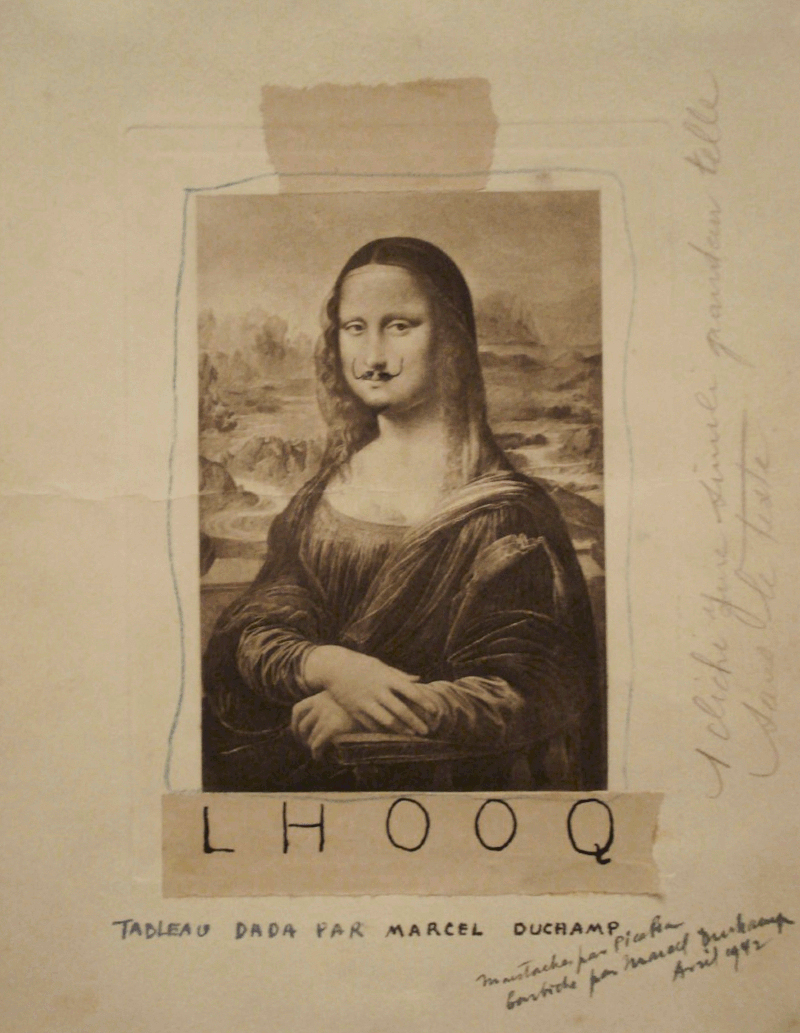
As Yeats and Duchamp already understood back in 1919 - over a century ago.
There is no going back to the curated ignorance of the "before." The task now is no longer about learning how to put the masks back on. It is about deciding how we are going to live with each other now that we are finally beginning to understand exactly who (and what) we actually are.